News
Buzzer Potting Machine Automatic Epoxy Dispensing and Encapsulation System
Why Buzzers Need Professional Potting
Buzzers — whether piezoelectric, magnetic, or electromagnetic — are precision sound components used in home appliances, automotive dashboards, medical devices, security systems, and industrial control panels. Inside every buzzer is a delicate resonant structure: a ceramic piezo element or an electromagnetic coil and diaphragm. These internal components are sensitive to moisture, dust, vibration, and temperature fluctuation.
Without proper encapsulation, buzzers fail prematurely: sound quality drifts, volume drops, internal elements detach, and moisture causes corrosion. That is why virtually every buzzer manufacturer uses epoxy or polyurethane potting to seal the assembly inside the plastic or metal housing.
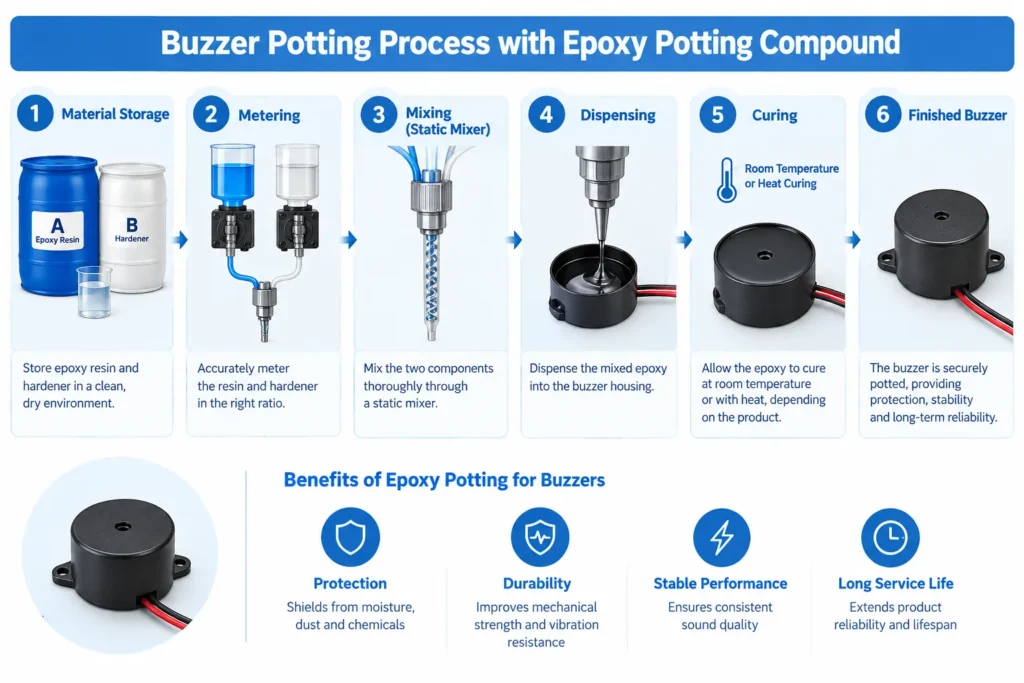
buzzer epoxy dispensing machine
The Problem with Manual Potting
Small-batch buzzer production often relies on manual dispensing: an operator mixes two-component epoxy by hand, fills each buzzer housing with a syringe, and waits for curing. This approach creates consistent quality problems:
- Inconsistent mix ratio → incomplete curing, soft spots, air pockets
- Uneven fill level → some buzzers underfilled, others overflowing
- Air bubbles trapped inside → acoustic resonance changes, volume variation
- Material waste → manual metering is imprecise, 5–10% material loss per shift
- Labor bottleneck → one operator can only fill a few hundred pieces per hour
For manufacturers scaling from prototype to mass production — especially for automotive-grade or medical-grade buzzers that require RoHS and IP65 sealing — manual potting is no longer viable.
What Is a Buzzer Potting Machine?
A buzzer potting machine is an automated two-component meter-mix-dispensing system engineered specifically for the small, high-precision housing volumes of buzzers, speakers, micro transducers, and similar acoustic components.
Unlike general-purpose glue dispensers, a dedicated buzzer potting machine is configured for the low-to-medium shot volumes (typically 2–30 ml per piece) used in buzzer encapsulation, with precision metering pumps that maintain ±1% ratio accuracy even at very small dispense amounts.
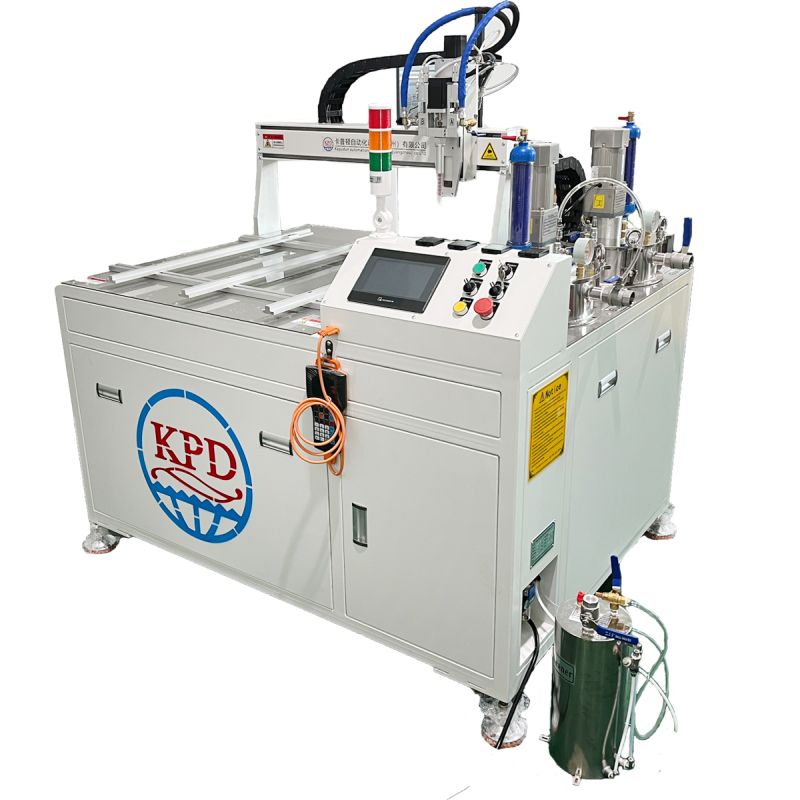
glue potting machine
Key Features
| Feature | Description |
|---|---|
| High-Precision Servo Metering | Servo-driven gear or piston pumps deliver consistent A/B ratio, adjustable from 1:1 to 10:1 by volume |
| Vacuum Degassing Option | Integrated vacuum chamber removes trapped air from the mixed material before dispensing, eliminating bubbles inside the buzzer housing |
| Dynamic Mixing Valve | Static or dynamic mixing ensures homogeneous epoxy/polyurethane blend, adjustable for fast- or slow-curing materials |
| Heated Material Tanks | Temperature-controlled A and B material tanks maintain viscosity stability, especially important for filled epoxies containing silica or alumina |
| Follow-Plate Pump System | For high-viscosity potting compounds, follow-plate pumps eliminate air entrapment during material pickup |
| XYZ Motion Platform | Programmable 3-axis or 4-axis platform follows complex buzzer geometries, including round, square, and custom housing shapes |
| PLC + Touchscreen HMI | Recipe storage for up to 100 buzzer models; one-button changeover between product types |
| Leak-Free Dispensing Nozzle | Spring-loaded or suction-cutoff nozzle prevents stringing and dripping between shots |
Advantages
- Consistent Acoustic Performance — Uniform fill height and bubble-free encapsulation ensure every buzzer meets the same sound pressure level (SPL) and frequency specification, reducing unit-to-unit variation.
- Higher Throughput — An automated system dispenses 600–1,500 buzzers per hour, depending on shot volume and cycle time, compared to 200–400 pieces per hour manually.
- Material Savings — Precise volumetric metering cuts material waste by 5–8%, which adds up significantly when using filled or specialty potting compounds.
- Improved Sealing Reliability — Vacuum degassing and controlled fill eliminate voids, helping buzzers achieve IP65 or higher ingress protection ratings.
- Labor Reduction — One operator can manage multiple machines simultaneously, freeing staff for assembly and testing.
- Traceability & Quality Control — PLC records batch numbers, material ratios, and dispense volumes, supporting ISO 9001, IATF 16949, and medical device quality audits.
Applications
A buzzer potting machine serves a wide range of acoustic and electronic component encapsulation tasks:
- Piezoelectric buzzers — epoxy sealing for SMD and through-hole piezo transducers
- Magnetic / electromagnetic buzzers — polyurethane or soft epoxy potting for moving-coil buzzers
- Buzzer assemblies with driving circuits — encapsulating both the transducer and the PCB driver in a single housing
- Micro speakers and receivers — precision potting for wearable and hearable devices
- Piezo sirens and alarms — heavy-duty encapsulation for outdoor and industrial alarm devices
- Microphone capsules — acoustic port sealing and rear-volume potting
- Tactile buzzers / haptic feedback modules — potting for smartphone and automotive haptic components
Which Materials Work Best?
- Epoxy resins — Best for hard, rigid encapsulation with excellent electrical insulation and mechanical strength. Ideal for automotive and industrial buzzers.
- Polyurethane (PU) — Flexible, shock-absorbing potting compound preferred for consumer electronics and applications subject to vibration or thermal cycling.
- Silicone — Used where high-temperature resistance or low stress on sensitive piezo ceramics is required.
The machine’s material tanks, pump seals, and wetted parts can be specified for any of these chemistries.
Bottom Line
If your buzzer production is still relying on manual or semi-automatic dispensing, an automated buzzer potting machine is not just an upgrade — it is the prerequisite for consistent quality at scale. From laboratory prototyping lines to fully automated production cells integrated with conveyors and curing ovens, the right meter-mix-dispensing system turns a labor-intensive bottleneck into a stable, repeatable process.
Contact KPD Automation for a sample test with your buzzer housing and potting material — we will configure the exact pump ratio, shot volume, and motion path for your product line.
Email: [email protected]