News
Why Do Water Meters Need Potting? Understanding the Benefits of Water Meter Encapsulation
With the rapid development of smart water meters and IoT-enabled metering devices, water meters must do more than provide accurate measurements. They must also maintain stable and reliable performance under humid and demanding operating conditions. Smart water meters, in particular, contain sensitive electronic components such as printed circuit boards (PCBs), sensors, batteries, and communication modules. Protecting these components against moisture, water ingress, and environmental interference has become an important part of water meter manufacturing.
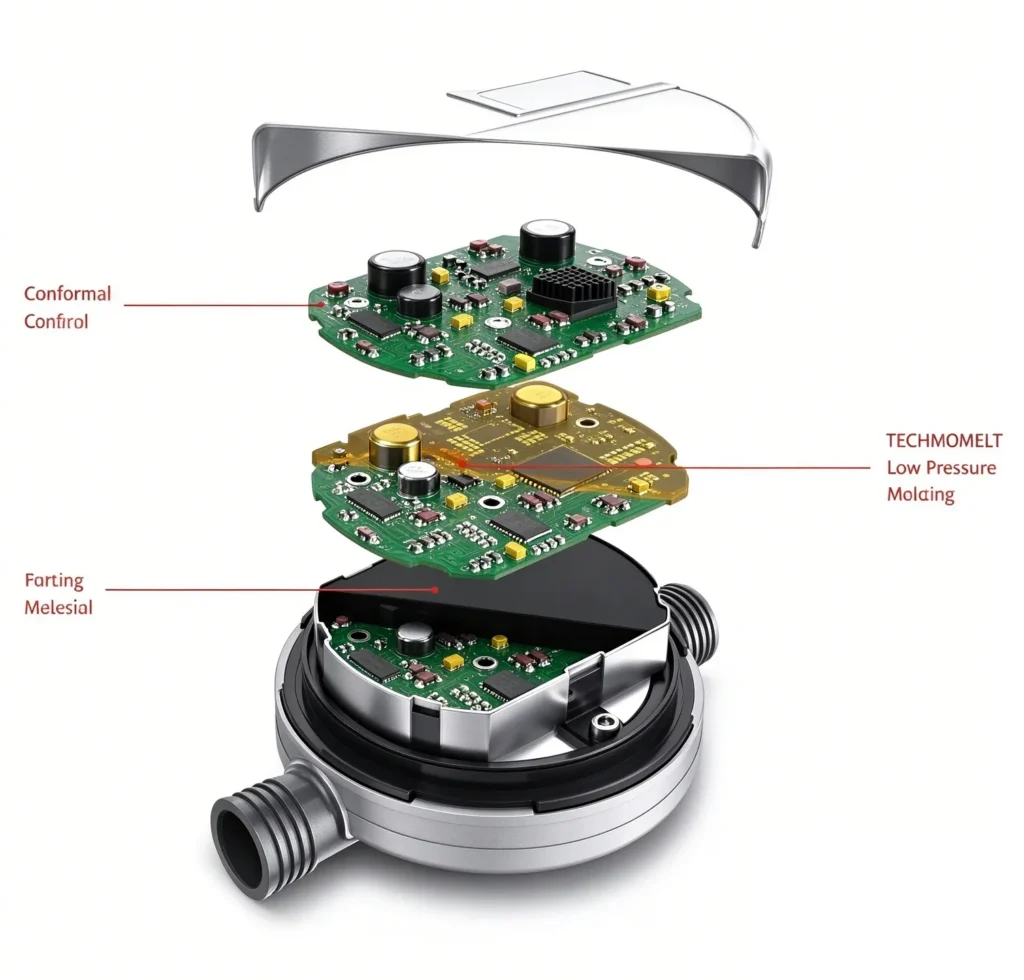
Water meter PCB epoxy potting and encapsulation
Potting is an effective process for improving the reliability and durability of electronic components in smart water meters.
1. Why Do Water Meters Need Potting?
1.1 Waterproofing and Moisture Protection
Water meters are often installed in underground utility chambers, damp pipeline environments, outdoor locations, and other areas exposed to moisture. Over time, moisture penetration and condensation may cause PCB corrosion, electrical short circuits, and electronic component failure.
By encapsulating electronic components with suitable materials, such as epoxy resin, polyurethane, or silicone potting compounds, manufacturers can reduce the risk of damage caused by moisture, condensation, and contaminants. This helps improve the reliability of electronic modules operating in challenging environments.
1.2 Corrosion Resistance and Extended Service Life
During long-term operation, electronic components inside water meters may be exposed to dust, contaminants, and corrosive environmental conditions.
Potting compounds form a protective layer around circuit boards and selected electronic components, reducing direct contact with external contaminants. This helps minimize the risk of metal contact oxidation, circuit corrosion, and other potential failures, contributing to a longer service life for electronic modules.
1.3 Mechanical Protection Against Vibration and Shock
Water meters may experience mechanical vibration and impact during transportation, installation, and operation. These forces can affect sensitive components, solder joints, and electrical connections.
Suitable potting materials help secure electronic components and absorb certain mechanical stresses, reducing the risk of component movement, solder joint fatigue, and wiring damage.
1.4 Improved Electrical Insulation
The circuit boards and electronic components inside smart water meters require reliable electrical insulation. Potting compounds with appropriate dielectric properties can help isolate conductive components and reduce the risk of electrical leakage or short circuits under humid or contaminated conditions.
1.5 Protection for Sensors and Communication Modules
Modern smart water meters often incorporate flow sensors, metering circuits, wireless communication modules, and data acquisition units. These components have specific requirements regarding their operating environment and assembly processes.
A properly designed potting solution can protect suitable electronic modules from moisture, contaminants, and mechanical stress, helping ensure stable data acquisition and transmission.
However, antennas, acoustic sensors, moving components, and heat-generating elements may not be suitable for direct encapsulation. The potting process should always be designed according to the product’s structure and performance requirements.
2. Which Potting Materials Are Commonly Used for Water Meters?
Different types of water meters require different potting materials depending on their design, operating environment, and performance requirements.
Epoxy Potting Compound
Epoxy potting compounds generally offer strong adhesion, high mechanical strength, and good electrical insulation properties. They are suitable for electronic modules requiring rigid structural protection and long-term stability.
When selecting epoxy resin, manufacturers should consider curing shrinkage, exothermic heat, material brittleness, and compatibility with electronic components.
Polyurethane (PU) Potting Compound
Polyurethane potting compounds can provide good flexibility, depending on the formulation. They are available in different hardness levels and can offer cushioning and stress-relief properties for electronic components.
PU potting compounds are suitable for certain electronic assemblies that require flexibility and resistance to mechanical stress and vibration.
Silicone Potting Compound
Silicone potting compounds generally offer excellent flexibility and temperature resistance. They are suitable for electronic modules that require reduced thermal stress or must withstand temperature fluctuations.
Their moisture resistance, adhesion, and chemical resistance depend on the specific formulation and application.
When selecting a potting compound, manufacturers should evaluate operating temperature, sealing requirements, viscosity, curing time, material compatibility, repairability, and overall cost rather than focusing solely on hardness or waterproofing performance.
3. What Are the Key Requirements for Water Meter Potting?
High-quality encapsulation depends not only on the potting material but also on the manufacturing process.
- Accurate mixing ratio: Two-component potting compounds must be mixed according to the specified ratio to prevent incomplete curing caused by incorrect proportions.
- Uniform mixing: Thorough mixing ensures consistent material properties throughout the encapsulated assembly.
- Bubble control: Depending on the application, vacuum degassing or other suitable techniques can help minimize air bubbles and voids.
- Precise dispensing volume: Controlling the amount and location of the dispensed material helps prevent overflow and incomplete encapsulation.
- Controlled curing: Curing temperature and time should follow the material manufacturer’s recommendations to achieve the required properties.
- Strict quality testing: Appropriate waterproofing, insulation, temperature cycling, and reliability tests should be performed to verify the encapsulation process.
For smart water meter manufacturers operating at scale, automated two-component metering, mixing, and dispensing systems can improve production consistency, reduce manual operating errors, and increase manufacturing efficiency.
4. What Benefits Does Potting Bring to Water Meter Manufacturers?
Water meter potting is more than simply filling an electronic assembly with resin. It is an integrated process involving material selection, structural design, and process control to improve overall product reliability.
For water meter manufacturers, a properly designed potting solution can help:
- Reduce the risk of moisture-related damage, corrosion, and contamination.
- Improve the stability of electronic modules under demanding operating conditions.
- Enhance the vibration and impact resistance of selected components.
- Improve production consistency and potentially reduce after-sales maintenance costs.
- Support the long-term reliability of smart water meters.
It is important to note that potting compounds cannot completely replace water meter housings, sealing rings, or structural waterproofing designs. The final waterproofing performance depends on the combined effectiveness of enclosure design, sealing structures, material compatibility, manufacturing processes, and product testing.
5. Choose the Right Potting Equipment to Improve Water Meter Manufacturing Quality
As smart water meters continue to become smaller, more integrated, and more intelligent, traditional manual potting methods may face challenges in dispensing accuracy, mixing consistency, and production efficiency.
Automated dispensing systems can provide controlled material delivery, precise two-component mixing ratios, dynamic mixing, and consistent dispensing according to the structure of the water meter’s electronic assembly and the requirements of the production process.
For manufacturers producing smart water meters, electronic flow meters, and other measuring instruments in large quantities, selecting the right potting equipment and encapsulation materials is an important step toward improving product reliability and manufacturing efficiency.
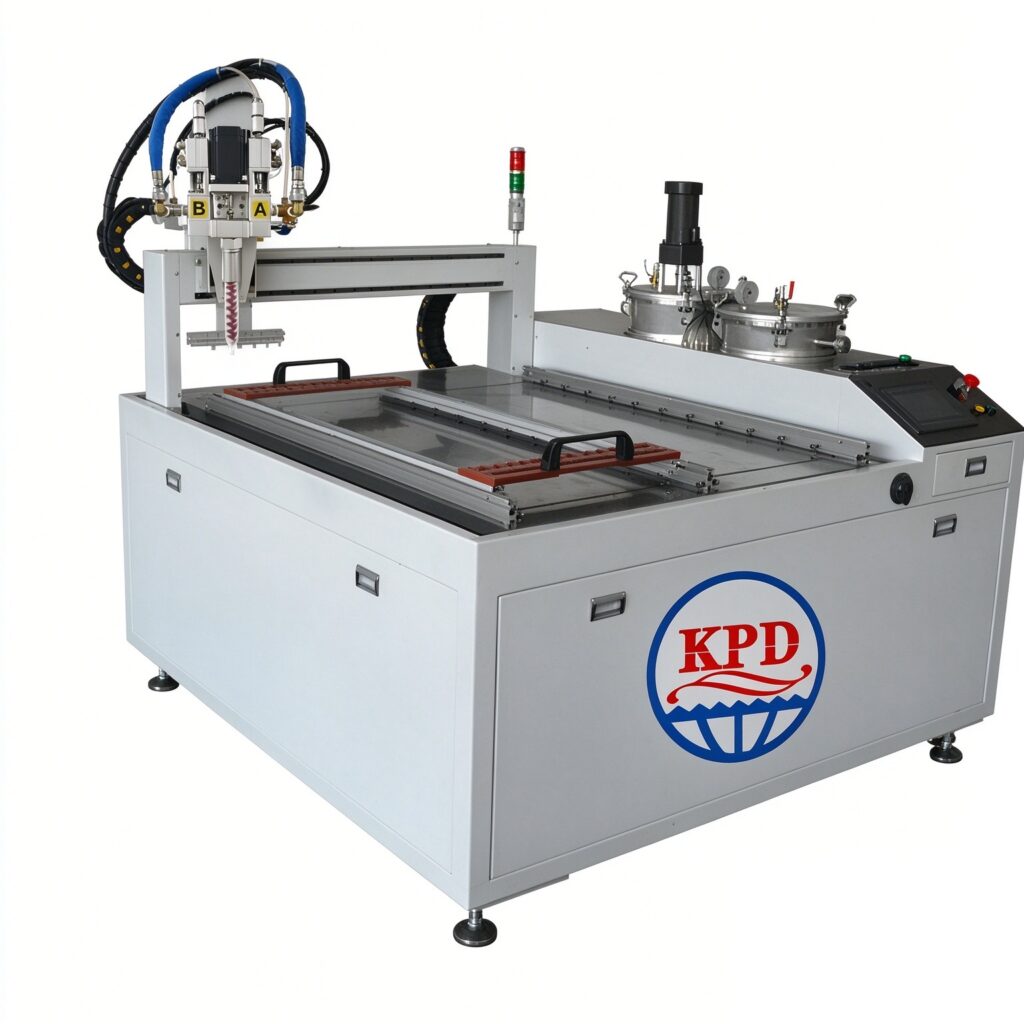
Automatic Epoxy Pouring and Filling Machine
Conclusion
The primary purpose of water meter potting is to provide targeted protection for internal electronic components against moisture, corrosion, electrical hazards, and mechanical stress.
By selecting suitable potting materials, optimizing dispensing and curing processes, and using reliable automated equipment, water meter manufacturers can better address the challenges of demanding operating environments and support the long-term, stable performance of smart water meters.
FAQ
Q1: What is a water meter reader glue dispensing machine?
It is a dispensing system used to apply adhesive, sealant, or potting materials to electronic components in water meter readers and smart water meter assemblies.
Q2: Which potting materials can be used for water meter electronics?
Common options include epoxy, polyurethane, and silicone. The appropriate material depends on moisture protection requirements, flexibility, operating temperature, and component compatibility.
Q3: Can the machine handle two-component epoxy?
Yes, a machine configured for two-component dispensing can meter and mix epoxy resin and hardener at a specified ratio. Compatibility depends on the material and machine configuration.
Q4: Does potting make a water meter completely waterproof?
Not necessarily. Potting protects the components it covers, but the overall waterproof performance also depends on housing design, seals, connectors, material compatibility, and product testing.
Q5: How do I choose a suitable water meter potting machine?
Consider the required dispensing volume, material viscosity, mixing ratio, accuracy, component geometry, production capacity, and curing process.
About Machine details please contact by whatsapp+86 134 2516 4065