News
Manufacturer of Automotive Sensor Potting Machines: Technical Key Points of Sensor Potting Equipment
Manufacturers of automotive sensor dispensing machines specialize in the research, development, manufacturing, and sales of dispensing equipment for automotive sensors. Automotive sensors operate in complex environments, including vibration, humidity, and temperature variations. To ensure the stable operation of internal electronic components, a dispensing process is typically used to inject adhesive into the sensor housing, providing insulation, moisture protection, and shock resistance. Manufacturers of this type of equipment provide complete sets of equipment and process solutions focusing on the metering, mixing, conveying, and control aspects of the dispensing process.
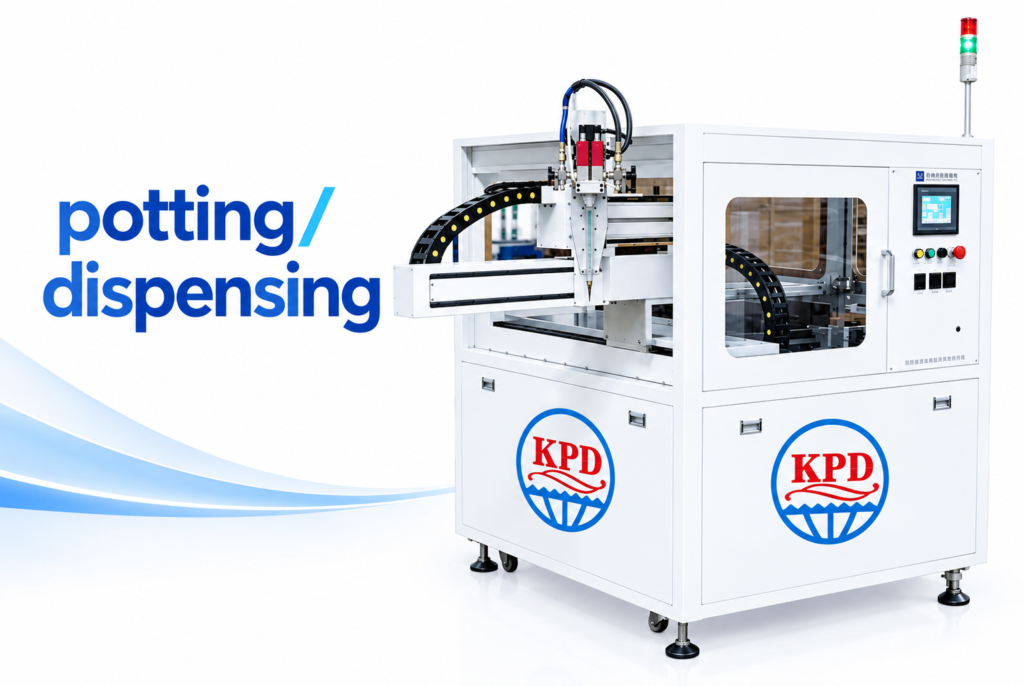
two part epoxy dispensing machine for sensor
From a technical standpoint, the core tasks of an automotive sensor dispensing machine involve two steps: first, precisely metering the two-component adhesive according to a set ratio; and second, quantitatively dispensing the mixed adhesive into the sensor. Many sensors use epoxy resin, polyurethane, or silicone adhesives. These materials are fluid before curing and form a protective layer after curing. The dispensing machine needs a precision pump and mixing valve to ensure the adhesive is mixed and dispensed within its pot life, avoiding poor curing due to mismatched proportions or uneven mixing.
A manufacturer’s technical capability is often reflected in their depth of understanding of adhesive properties. Different adhesives vary greatly in viscosity, curing speed, and filler content. For example, high-filler adhesives can easily cause wear on the pump body, requiring a specially designed plunger pump; polyurethane adhesives are sensitive to moisture, requiring controlled humidity in the operating environment; silicone adhesives have significant viscosity variations, demanding higher stability from the metering system. Therefore, manufacturers of automotive sensor dispensing machines need to combine the adhesive characteristics and sensor structure to adjust the design of the adhesive supply pipeline, mixing valve, and dispensing nozzle to achieve stable production.
In actual production, several key process steps deserve attention.
First is metering accuracy. Insufficient glue application may prevent the complete assembly of electronic components, while excessive application may cause overflow or affect assembly. High-precision metering pumps and closed-loop control systems are fundamental to ensuring glue application quality. The accuracy of the metering system is typically affected by factors such as pump manufacturing precision, motor control stability, and glue temperature variations.
Second is mixing effectiveness. When using a static mixing tube, the two glues are continuously divided and reversed within the tube through a spiral structure, achieving uniform mixing. Dynamic mixing uses a motor-driven stirring blade, suitable for glues with short shelf lives or high filler content. Manufacturers need to select or customize the mixing method based on the glue type and production volume requirements.
Third is air bubble control. If air bubbles are present inside the sensor after glue application, they may cause partial discharge or insulation failure under high pressure. Therefore, some equipment is equipped with vacuum glue application functionality, allowing bubbles to escape under negative pressure during application. Other equipment employs online degassing or secondary vacuuming processes to further reduce air bubble content.
For users, understanding the equipment structure and working principles of automotive sensor dispensing machine manufacturers helps in more rationally assessing whether the equipment matches their own process requirements. Key aspects to consider include: whether the adhesive system is compatible with the equipment’s materials, whether the metering and mixing system can meet product consistency requirements, the ease of cleaning and maintenance, and the stability of the equipment during long-term continuous operation.
From an industry perspective, automotive sensor dispensing machine manufacturers occupy a crucial position at the intersection of upstream equipment manufacturing and downstream electronic component production. The protection quality of sensors directly determines their lifespan and reliability, and dispensing, as a critical process, directly impacts product quality due to the stability and accuracy of the equipment. As technology providers, manufacturers typically need to integrate knowledge in mechanical design, fluid control, automation control, and materials application, which to some extent determines the technical level and reliability of the equipment.
Furthermore, automotive sensor products are diverse, including temperature sensors, pressure sensors, position sensors, and speed sensors, each with varying dimensions, dispensing nozzle shapes, and dispensing volume requirements. Therefore, experienced manufacturers adjust the fixtures, positioning systems, dispensing paths, and conveying methods according to the specific sensor type. The equipment often appears in semi-automatic or fully automatic form, and can be configured with single or multi-station options as needed.
Overall, the core value of automotive sensor dispensing machine manufacturers lies in integrating adhesive characteristics, sensor structure, and automated production line requirements into a feasible dispensing process solution. Understanding these technical principles helps industry professionals establish clearer judgment criteria during equipment selection and production debugging, thereby avoiding equipment-product mismatch issues caused by insufficient process understanding.
Machine details please contact by whatsapp+86 134 2516 4065
Or you can view my youtube channel : https://www.youtube.com/@abgluedispensingmachine