News
Automotive Sensor Epoxy dispensing Machine for Vehicle Pressure and Radar Sensors
Modern intelligent vehicles rely heavily on automotive sensors to deliver safe and stable driving performance. From ADAS radar modules to tire pressure TPMS sensors, engine oil pressure sensors and coolant temperature sensors, these electronic assemblies must withstand harsh under-hood environments: extreme thermal cycling, continuous mechanical vibration, road salt spray, moisture and chemical contamination.
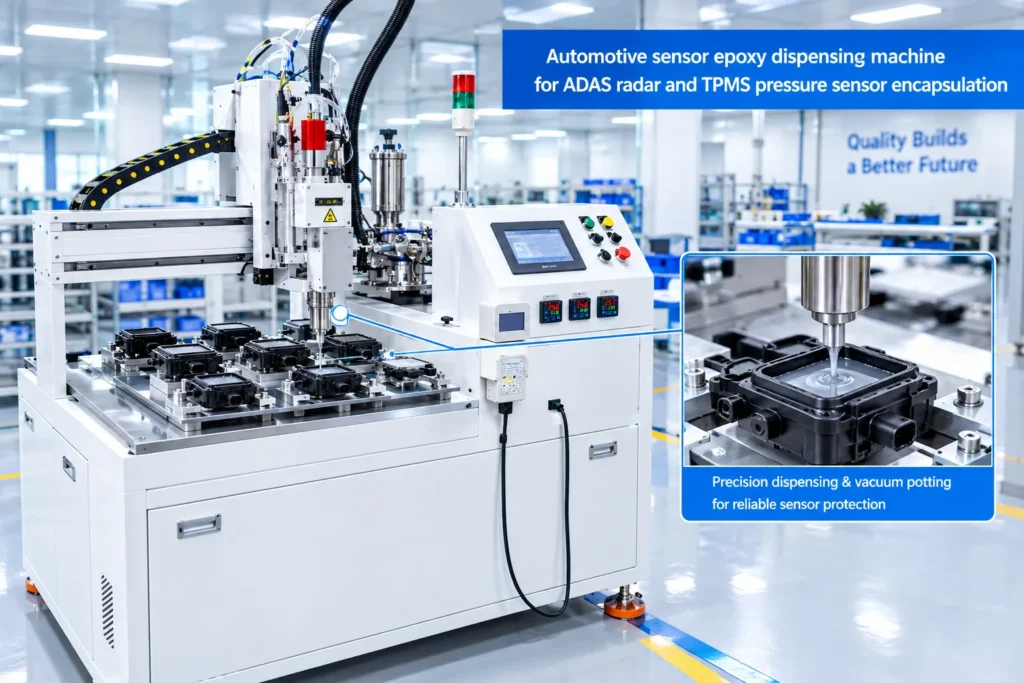
Epoxy potting is the most trusted packaging method for these high-reliability automotive sensors. A professional automotive sensor epoxy dispensing machine accurately meters, mixes and dispenses two-component epoxy resin, forming a rigid, high-insulation protective shell for radar and pressure sensors. Compared with manual dispensing, automatic epoxy dispensing equipment eliminates inconsistent glue ratios, incomplete filling and trapped bubbles, helping automotive Tier 1 suppliers and sensor manufacturers meet strict AEC-Q100 automotive reliability requirements.
finished-epoxy-potted-automotive-radar-pressure-sensor.
Why Epoxy Is Preferred for Automotive Radar and Pressure Sensors
Automotive-grade epoxy potting compounds feature high mechanical strength, excellent dielectric insulation, strong adhesion to PCBs, metal housings and sensor chips, plus resistance to oil, fuel and salt corrosion. For radar modules, epoxy potting protects delicate RF circuit boards from vibration damage while maintaining stable signal transmission. For TPMS and fluid pressure sensors mounted inside tires or engine compartments, cured epoxy prevents water ingress and thermal fatigue during long-term temperature swings from -40°C to 150°C.
However, epoxy’s performance can only be fully realized with precise mixing and bubble-free dispensing. Manual mixing leads to ratio deviation, air entrapment and inconsistent layer thickness. Tiny bubbles hidden inside epoxy will expand under thermal shock, cracking the encapsulation and causing sensor failure during road tests. This is the main reason mass-production automotive sensor factories switch to automatic epoxy dispensing and vacuum potting systems.
Core Features of Our Automotive Sensor Epoxy Dispensing Machine
1. High Precision 2-Component Meter-Mix System
This automotive sensor epoxy dispensing machine adopts precision metering pumps to control the mixing ratio of A/B epoxy resin. Ratio can be customized such as 2:1, 3:1 or 4:1 according to your epoxy material specification. The glue output volume is controllable with high repeatability, ideal for micro-volume dispensing on compact radar sensor PCBs and small pressure sensor cavities. Every batch maintains identical epoxy weight and thickness, which is critical to pass automotive reliability aging tests.
2. Optional Vacuum Potting Function for Bubble-Free Encapsulation
Trapped bubbles are a top failure mode for automotive sensor epoxy packaging. Our vacuum potting configuration mixes and dispenses epoxy inside a low-pressure chamber, removing air bubbles before curing. Vacuum dispensing ensures full cavity filling without voids, improving IP protection and long-term stability of radar and pressure sensors. It drastically cuts defective rates during accelerated thermal cycling and vibration testing.
3. Stable Dispensing for High Viscosity Automotive Epoxy
Many automotive under-hood epoxy potting compounds are high-viscosity filled resin with thermal conductive fillers. This dispensing machine handles filled epoxy smoothly without sedimentation or pump clogging. The dynamic mixing head guarantees uniform blending of filler and resin, avoiding filler separation that often occurs with low-end dispensing equipment.
4. Programmable Dispensing Path & PLC Intelligent Control
Users can store multiple dispensing programs for different sensor models: radar modules, TPMS pressure sensors, brake fluid pressure sensors and transmission sensors. Operators quickly switch recipes for small batch trial runs or high-volume mass production. The system records dispensing parameters for full production traceability, which is required for automotive OEM quality audits.
5. Automotive Manufacturing Compliant Design
The machine supports continuous 24-hour operation for automotive electronics production lines. It comes with automatic cleaning function for mixing head to prevent epoxy curing and blockage during shift change. All wetted parts can be customized for different epoxy chemistries, supporting RoHS and automotive-grade potting materials.
Main Application: Radar Sensors & Pressure Sensors
- ADAS Radar Sensor Modules 77GHz millimeter wave radar sensors for adaptive cruise control and collision warning. Epoxy potting protects RF boards and antenna components from vibration and moisture, preserving radar detection accuracy.
- TPMS Tire Pressure Sensors Extreme centrifugal force and wide temperature fluctuation inside tires demand rigid epoxy encapsulation. Automatic epoxy dispensing ensures consistent potting quality for large-scale TPMS sensor manufacturing.
- Engine & Hydraulic Pressure Sensors Oil pressure, coolant pressure and brake pressure sensors installed in underhood or brake systems. Cured epoxy resists engine oil, brake fluid, high temperature and vibration to maintain stable pressure signal output.
- Other Automotive Sensing Components Temperature sensors, collision impact sensors and transmission position sensors requiring rigid epoxy encapsulation and high dielectric strength.
How to Match the Epoxy Dispensing Machine To Your Automotive Sensor Production
When selecting an automotive sensor epoxy dispensing machine, you need to evaluate four key factors. First, confirm your two-part epoxy mixing ratio and resin viscosity. Filled thermal conductive epoxy requires stronger pumping power than low-viscosity unfilled epoxy. Second, check the dispensing volume range. Miniature radar sensors need micro-dispensing accuracy, while larger pressure sensor housings need higher flow rates. Third, decide whether vacuum potting is required. Radar and safety-critical pressure sensors almost always need vacuum defoaming to eliminate voids. Fourth, evaluate your production volume. Semi-automatic tabletop machines fit R&D and pilot lines, while fully automatic inline dispensing systems integrate with conveyor for mass production.
Conclusion
Automotive radar and pressure sensors are safety-critical parts in modern vehicles. Poor epoxy potting quality directly leads to field failure and costly product recalls. An automotive sensor epoxy dispensing machine delivers repeatable, void-free, ratio-accurate epoxy encapsulation for automotive sensors