News
Automatic vs Semi-Automatic Potting Machine: Which One to Pick ?
When shopping for two-component epoxy potting equipment, manufacturers often face a core question: should you choose an automatic potting machine or a semi-automatic potting machine? Both systems can dispense and mix two-part adhesives, but they differ greatly in working logic, labor cost, throughput and applicable production lines. Making the right choice directly affects your production efficiency and long-term manufacturing budget.
Working principle difference
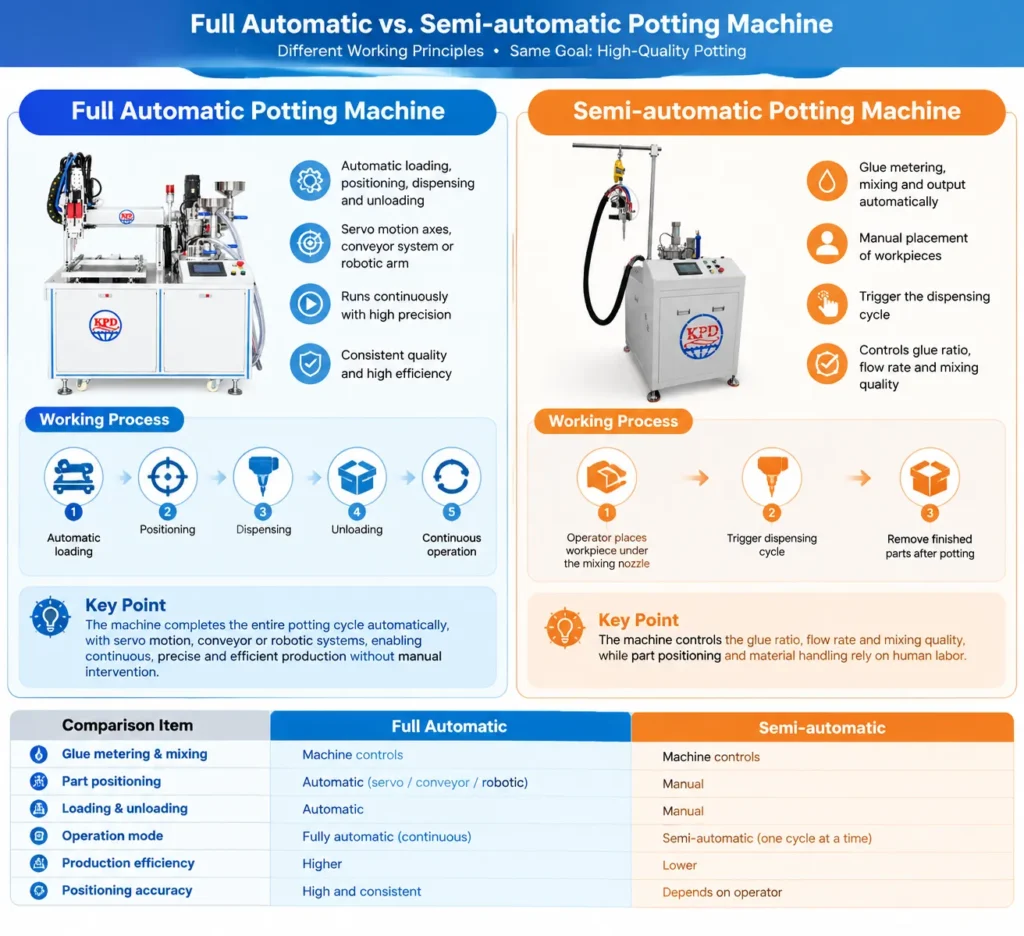
A semi-automatic potting machine mainly handles glue metering, mixing and glue output. Operators manually place workpieces under the mixing nozzle, trigger the dispensing cycle, and remove finished parts after potting. The machine controls glue ratio, flow rate and mixing quality, while part positioning and material handling rely on human labor.
A fully automatic potting machine integrates automatic loading, positioning, dispensing, and unloading. It is usually equipped with servo motion axes, conveyor systems or robotic arms. Once the program is set, the machine repeats the whole potting cycle automatically without manual intervention for each workpiece. It can run continuously and precisely position parts according to pre-programmed paths.
Labor requirement and production capacity
Semi-automatic potting machines need at least one operator to load and unload components. One worker can usually manage one or two semi-auto stations. The output is limited by the speed of manual handling. It works well for medium or small batch runs, and the production rate is flexible to adjust.
Automatic potting systems greatly cut labor dependence. One operator can supervise multiple machines, mainly responsible for glue refilling, parameter checking and troubleshooting. Continuous operation brings higher hourly throughput. For mass production, automatic equipment delivers much higher output and stable cycle time, avoiding inconsistency caused by manual operation.
Price range and footprint
Semi-automatic potting machines feature lower upfront investment. The equipment structure is simpler, so purchase cost and spare part expense are more affordable. They also take up less factory floor space, easy to move and install in existing workshops with limited area.
Fully automatic potting machines carry higher initial costs, including servo motion, conveyor or robotic systems and automated fixtures. The whole system occupies larger workshop space. Besides machine price, you also need to budget for fixture customization and factory power or air supply modification.
Operation difficulty and flexibility
Semi-automatic potting machines are easier for operators to learn. Machine setup and recipe switching are fast. It is highly flexible for frequent product changes. When you produce many different types of electronic assemblies with small batch sizes, you can quickly swap fixtures and adjust programs.
Automatic potting systems require more professional training for programming and maintenance. Recipe switching takes longer, especially when custom fixtures are needed. It is less flexible for frequent product changes. Once the workflow is programmed, it performs best for fixed products with stable production requirements.
Suitable production scenarios
Semi-automatic potting machines are ideal for:
- Small and medium batch production
- Frequent product model changes
- Limited factory budget or workshop space
- Custom electronic assemblies, prototype production and pilot runs
Automatic potting machines fit these scenarios:
- High-volume mass production
- Stable product types with few design changes
- Strict requirements for consistent potting quality
- Production lines aiming to reduce labor cost and human error
Simple decision framework
Ask yourself these four questions before making a purchase:
- What is your daily production volume? If you need high continuous output, go for automatic machines. For small or flexible batches, semi-automatic is better.
- How often do you change products? Frequent model switching favors semi-automatic equipment.
- What is your budget and available factory space? If capital and floor area are limited, semi-automatic is a practical starting point.
- How strict is your requirement for consistency? Automatic systems deliver more repeatable potting results for high-standard mass manufacturing.
Conclusion
There is no universal “better” option between automatic and semi-automatic potting machines. The best choice depends on your production volume, product mix, budget and workshop layout. Many manufacturers start with semi-automatic potting equipment, then upgrade to fully automatic systems when their production scale grows.
FAQ
Q: What is the difference between automatic and semi-automatic potting machine? A: Semi-automatic potting machines handle glue metering, mixing and dispensing, while operators manually load and unload workpieces. Fully automatic potting machines integrate auto loading, positioning, dispensing and unloading, running continuously without manual handling for each part.
Q: Which one costs less, automatic or semi-automatic potting machine? A: Semi-automatic potting machines have much lower upfront purchase cost. Fully automatic systems require extra investment in servo axes, conveyor or robotic fixtures, which increases total expense.
Q: Is semi-automatic potting machine suitable for mass production? A: Semi-automatic potting equipment works best for small and medium batch production. It is not ideal for high-volume mass production because throughput is limited by manual loading and unloading.
Q: Can I switch products quickly on an automatic potting machine? A: Automatic potting machines are less flexible for frequent product changes. Recipe switching and fixture replacement take more time. Semi-automatic machines are better for multi-product, small-batch manufacturing.
Q: Which potting machine offers better dispensing consistency? A: Fully automatic potting machines provide more stable and repeatable potting quality. They eliminate human positioning errors and maintain consistent cycle time for large runs.
If you need further advice on potting machine configuration, contact our team for a custom solution matched to your epoxy and production targets.