News
Fan Motor Control PCB potting and encapsulation with 2 component epoxy dispenser
1. Introduction to Fan Motor Control PCB Potting
Fan motors are widely used in industrial cooling systems, household appliances, ventilation equipment, automotive electronics and other electrical applications. Inside a fan motor, the control PCB and electronic components play an important role in regulating motor operation and ensuring stable performance.
However, electronic control boards may be exposed to moisture, dust, vibration, temperature changes and other environmental factors during operation.
Fan Motor Control PCB Potting is an effective process for protecting sensitive electronic components by filling designated areas with protective resin.
Two-component epoxy resin is commonly used for this application because of its electrical insulation properties, mechanical strength and environmental resistance.
A 2 component epoxy dispenser provides an efficient solution for accurately metering, mixing and dispensing epoxy resin onto the target areas of fan motor control assemblies.
2. Why Is Epoxy Potting Necessary for Fan Motor Control PCBs?
The fan motor control PCB contains electronic components, solder joints, circuit connections and other sensitive parts. Without appropriate protection, these components may be affected by external environmental conditions.
Epoxy resin potting offers several important benefits.
Moisture and Dust Protection
Epoxy resin forms a protective layer around electronic components, helping prevent moisture, dust and contaminants from reaching sensitive circuit areas.
Electrical Insulation
Properly selected epoxy potting compounds provide electrical insulation and help protect electronic circuits from unwanted electrical contact.
Vibration Resistance
During fan operation, continuous vibration may affect electronic components and solder connections. Epoxy encapsulation can provide additional mechanical support and help reduce movement.
Improved Component Reliability
By protecting sensitive electronic components from environmental exposure, epoxy potting can help improve the long-term reliability of fan motor control assemblies.
3. Why Use a Two Component Epoxy Dispensing Machine?
Two-component epoxy materials generally consist of Part A (resin) and Part B (hardener). These materials must be mixed according to a specified ratio before application.
Manual mixing and dispensing may result in inconsistent mixing ratios, inaccurate dispensing volumes and material waste.
A 2 component epoxy dispensing machine automates the material feeding, metering, mixing and dispensing process.
Its main advantages include:
- Independent A and B material supply systems.
- Accurate control of the mixing ratio.
- Consistent dispensing volume.
- Automatic or programmable dispensing operation.
- Uniform material mixing through a static mixing tube.
- Optional heating and vacuum degassing systems.
- Customizable production configurations.
The equipment can be configured according to the epoxy resin viscosity, mixing ratio, working time and production requirements.
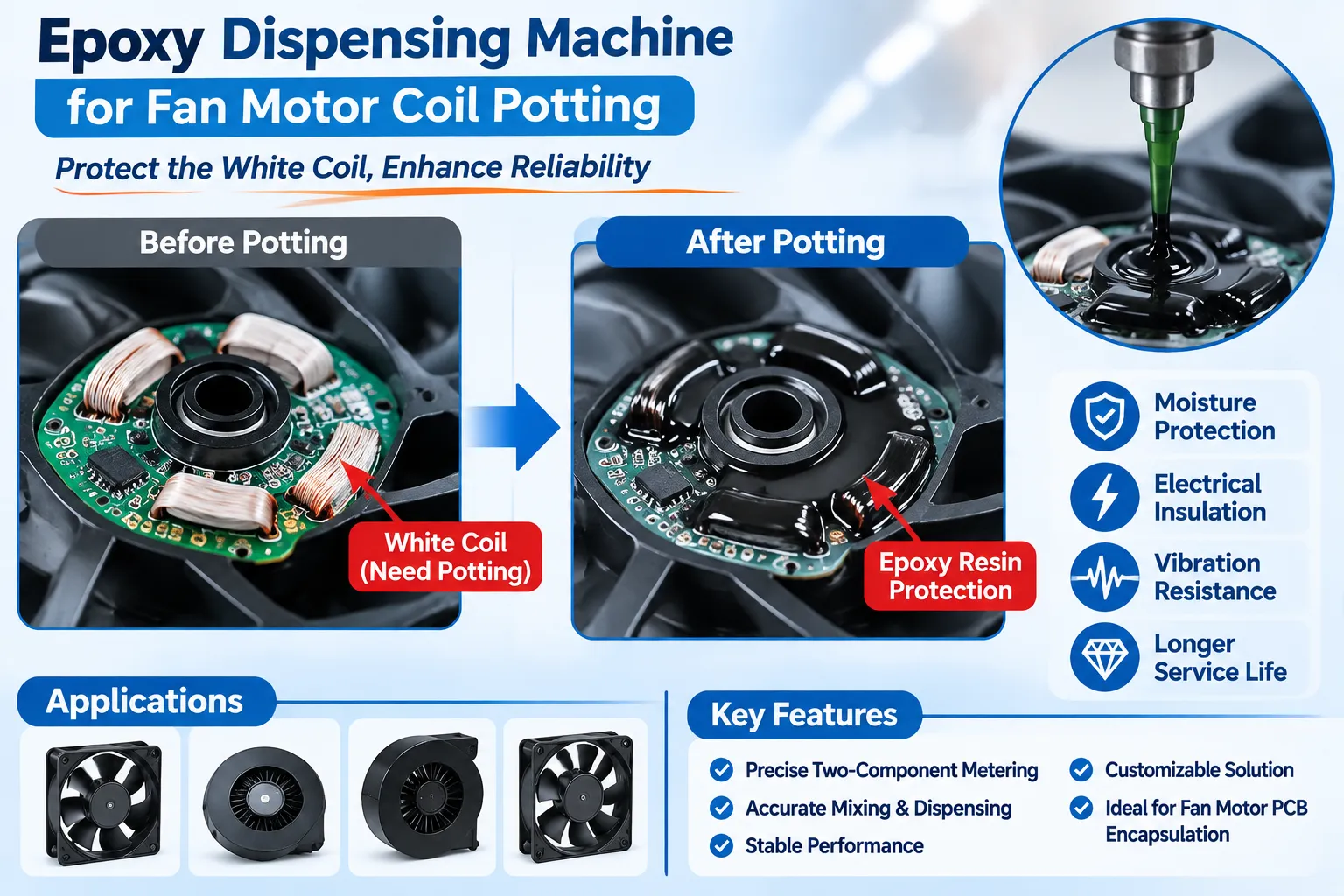
Fan Motor Coil Potting machine
4. How Does the Epoxy Dispensing Process Work?
The fan motor control PCB potting process involves several steps.
Step 1: Prepare the Fan Motor Components
The fan motor housing and control PCB are positioned in the designated fixture. The target coil windings or electronic areas requiring protection are identified.
The components should be clean and dry before dispensing.
Step 2: Prepare the Two-Component Epoxy Resin
Part A and Part B epoxy materials are loaded into separate storage tanks.
Depending on the material characteristics, the machine can be equipped with stirring, heating or vacuum degassing functions.
Step 3: Accurate A/B Material Metering
The independent metering system delivers Part A and Part B according to the required mixing ratio.
Accurate metering helps maintain consistent material properties and curing performance.
Step 4: Mixing and Dispensing
The two components enter the mixing system and are thoroughly combined through a static mixing tube.
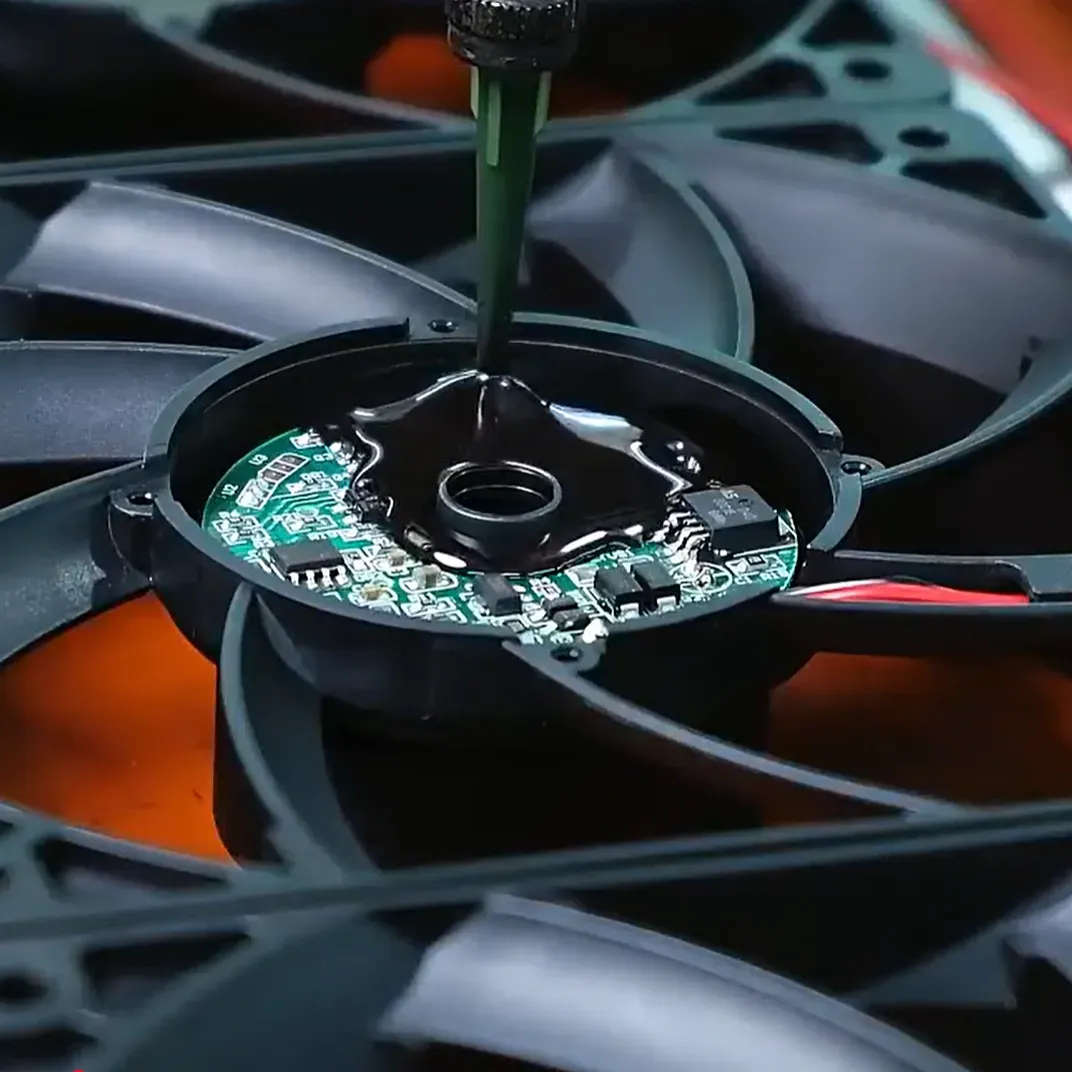
The mixed epoxy resin is then dispensed onto the designated white coil windings or other specified potting areas of the fan motor assembly.
The dispensing program can be adjusted to control the glue volume, dispensing position and dispensing speed.
The central bearing hole and other functional openings should remain free of resin whenever required by the product design.
Step 5: Curing Process
After dispensing, the fan motor assembly is transferred to the curing area.
The epoxy resin cures according to the adhesive manufacturer’s recommended temperature and curing time.
Once fully cured, the encapsulated assembly is ready for subsequent inspection and production processes.
5. Key Features of Our 2K Epoxy Dispensing Machine
Our two-component glue dispensing machines are designed for industrial electronic potting, encapsulation and adhesive applications.
Independent Material Feeding
Separate A and B material supply systems prevent premature mixing and allow independent material delivery.
Precise Metering and Mixing
The metering system controls the material ratio and dispensing volume according to the adhesive specifications.
PLC Control System
The touchscreen interface allows operators to set dispensing parameters and manage operating programs.
Vacuum Degassing Option
Vacuum degassing can help remove entrapped air from the resin before dispensing, reducing the risk of bubbles in the finished product.
Customized Dispensing Solutions
The equipment can be customized with different tank capacities, metering pumps, dispensing valves, fixtures and automation systems.
6. Applications of Two-Component Epoxy Potting
In addition to fan motor control PCB encapsulation, two-component epoxy dispensing machines can be used in many electronic manufacturing applications.
- Cooling Fan Motor PCB Potting
- Fan Motor Coil Encapsulation
- Electronic Control Board Potting
- LED Driver Encapsulation
- Transformer and Inductor Potting
- Sensor Electronics Encapsulation
- Power Supply PCB Protection
- Automotive Electronic Component Potting
- Industrial Control Module Encapsulation
The actual resin selection and dispensing configuration depend on the product structure and application requirements.
7. How to Choose the Right Epoxy Dispensing Machine?
Before selecting a 2K epoxy dispensing machine for fan motor PCB potting, manufacturers should consider several factors.
1. Epoxy Mixing Ratio
Confirm the required A/B mixing ratio according to the epoxy resin technical data sheet.
2. Material Viscosity
The viscosity of Part A and Part B determines the suitable material feeding and metering system.
3. Dispensing Volume
Calculate the required epoxy volume for each fan motor assembly to select the appropriate dispensing capacity.
4. Production Output
Determine whether manual, semi-automatic or fully automatic dispensing is suitable for the production line.
5. Dispensing Accuracy
The dispensing system should provide stable material delivery and repeatable glue application.
6. Optional Functions
Heating, stirring, vacuum degassing and automatic positioning can be selected according to material and production requirements.
8. Conclusion
Fan motor control PCB potting is an important process for protecting electronic components and improving product reliability.
Using a professional 2 component epoxy dispenser helps manufacturers achieve accurate material metering, consistent mixing and controlled resin dispensing.
Whether you need to encapsulate fan motor coils, protect control PCBs or automate electronic potting production, a customized two-component epoxy dispensing machine can provide an efficient and reliable solution.
Contact us to discuss your epoxy dispensing requirements and find the right equipment for your production process.