Products
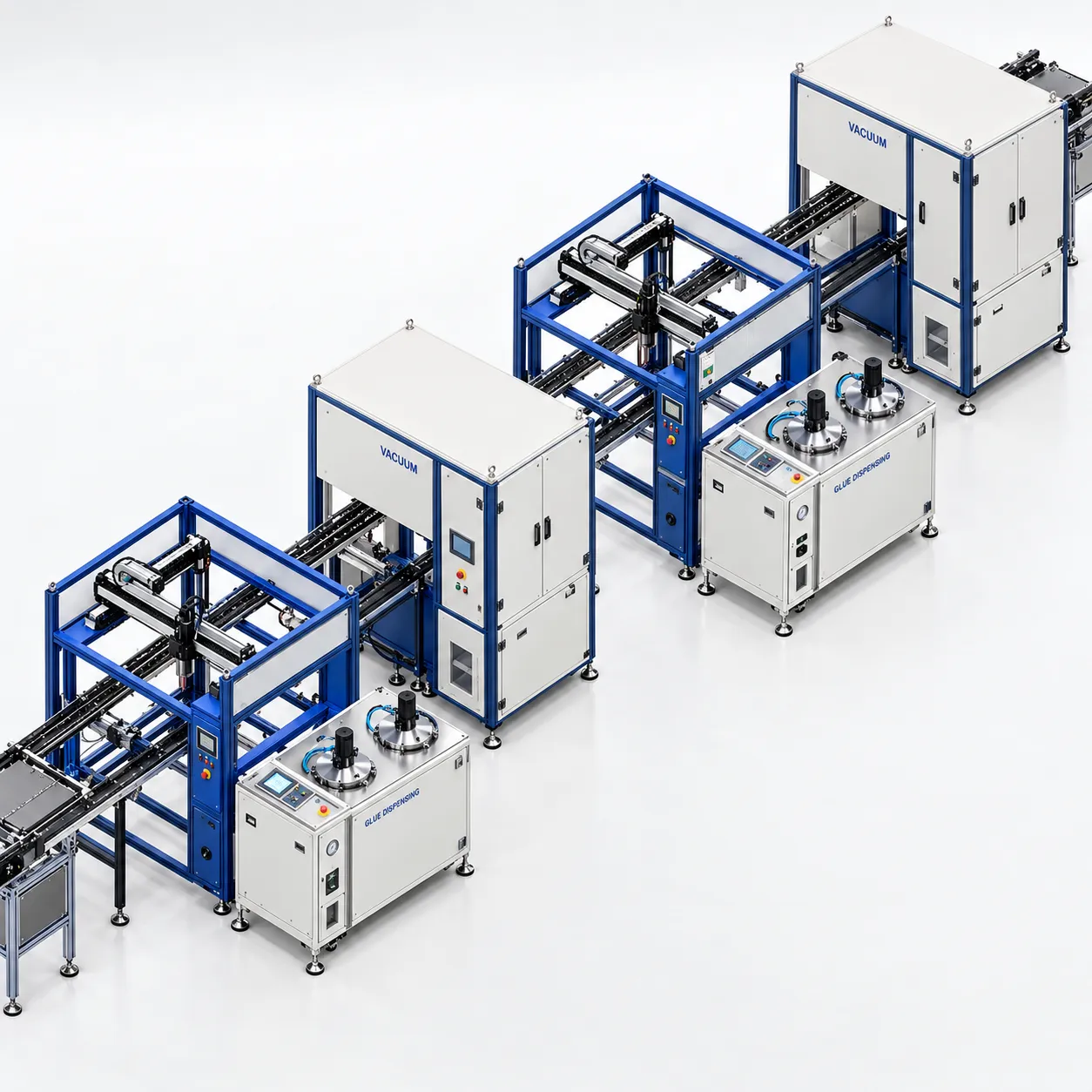
Automatic Potting Production Line with 2 Glue Dispensing Machines and 2 Vacuum Chambers
The KPD Automatic Potting Production Line consists of two glue dispensing machines and two vacuum chambers, designed to improve production efficiency and potting quality. The integrated system combines precision epoxy dispensing with vacuum processing to help reduce air bubbles and achieve consistent encapsulation. Suitable for transformers, electronic components, power modules, sensors and other electrical products, the production line can be customized with automated material handling, programmable controls and flexible process configurations to meet different manufacturing requirements.
The KPD Automatic Potting and Vacuum Production Line integrates two glue dispensing machines with two vacuum chambers to improve potting efficiency and process consistency. Designed for epoxy resin and other compatible potting compounds, the system supports automated dispensing, vacuum degassing or vacuum-assisted potting, and continuous production workflows for electronic components, transformers, power modules and industrial electrical products. The line layout can be customized according to workpiece dimensions, material properties and production requirements.
Key Features
- Dual Potting Stations: Two glue dispensing machines support parallel processing and flexible production scheduling.
- Dual Vacuum Chambers: Two vacuum chambers help reduce trapped air and bubbles in compatible potting processes.
- Precision Metering and Dispensing: Controlled glue output supports consistent filling volumes and repeatable potting quality.
- Automated Workflow: The production line can integrate workpiece loading, dispensing, vacuum processing and unloading.
- Flexible Material Compatibility: Suitable for compatible epoxy, silicone and polyurethane potting compounds, subject to material and process requirements.
- PLC and HMI Control: Configurable process parameters, operating status monitoring and alarm functions.
- Customizable Production Layout: Optional conveyors, fixtures, robotic handling and recipe management can be configured for specific applications.
Working Principle
Step 1 – Workpiece Loading
Electronic components or electrical assemblies are positioned in dedicated fixtures and prepared for the potting process.
Step 2 – Automatic Glue Dispensing
The first or second dispensing station applies a controlled quantity of potting compound according to the programmed dispensing path and process parameters.
Step 3 – Vacuum Processing
Workpieces are transferred into one of the two vacuum chambers for vacuum degassing or vacuum-assisted potting, depending on the selected process sequence. Reduced pressure helps remove trapped air and improve resin penetration where applicable.
Step 4 – Parallel Station Operation
The two dispensing machines and two vacuum chambers can be coordinated to reduce waiting time and improve equipment utilization. Actual parallel operation depends on cycle time, material curing characteristics and the configured transfer system.
Step 5 – Final Inspection and Unloading
After the required dispensing and vacuum treatment, the potted workpieces are removed for curing, inspection or the next production operation.
Production Line Advantages
Higher Production Capacity
Two dispensing stations and two vacuum chambers provide opportunities for parallel processing and improved equipment utilization.
Improved Potting Quality
Vacuum processing helps reduce air entrapment, supporting more uniform encapsulation and electrical insulation when the resin and process are properly matched.
Consistent Dispensing Results
Programmable dispensing paths and controlled material delivery help reduce variation between workpieces.
Reduced Manual Handling
An integrated layout can minimize repeated manual transfers and simplify coordination between dispensing and vacuum treatment.
Flexible Process Configuration
Dispensing, vacuum treatment, transfer and curing steps can be adjusted to suit different products and production targets.
Expandable Automation
Optional conveyors, robotic loading, barcode identification and production data tracking can be integrated according to project requirements.
Technical Specifications
| Item | Specification |
|---|---|
| Production line configuration | 2 potting machines + 2 vacuum chambers |
| Dispensing system | Single-component or two-component, depending on model |
| Applicable materials | Epoxy, silicone or PU compounds, subject to compatibility |
| Metering system | Configurable according to material and accuracy requirements |
| Vacuum system | 2 independent or coordinated vacuum chambers |
| Control system | PLC + touchscreen HMI |
| Workpiece handling | Manual, conveyor or automatic transfer |
| Dispensing mode | Point dispensing, filling, coating or potting |
| Vacuum control | Programmable vacuum level and processing time |
| Production layout | Customized according to workpiece and cycle time |
| Optional functions | Heating, stirring, material degassing, robotic handling and data logging |
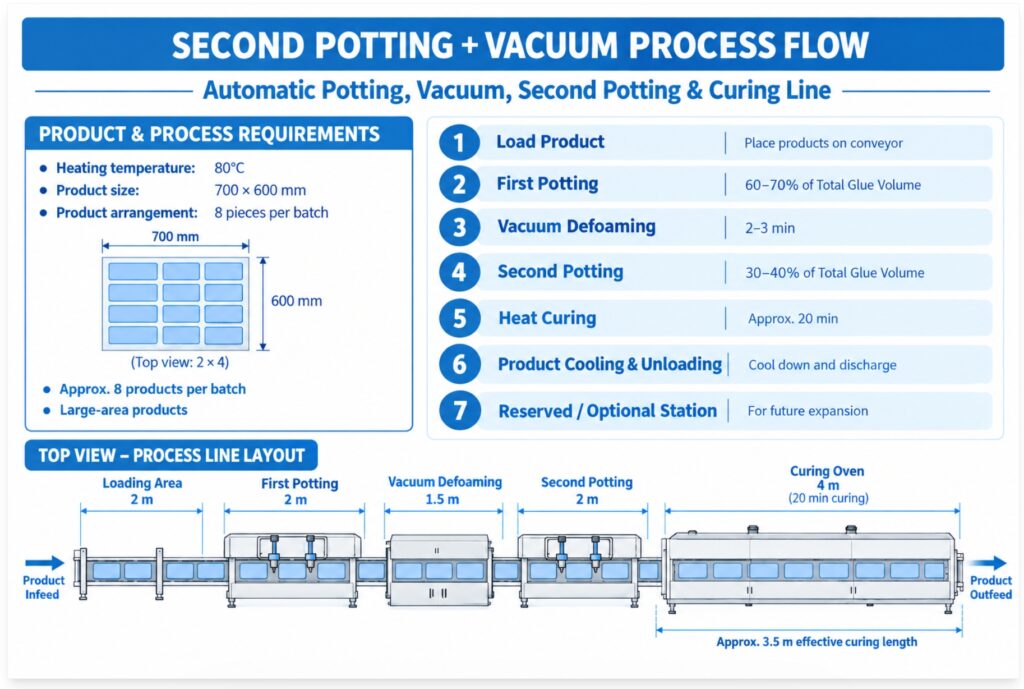
Below is example for our LED driver customer case
Applications
- Transformer coil potting and insulation
- Current and voltage transformer encapsulation
- Electronic control modules and PCB potting
- LED drivers and power supply encapsulation
- Sensors and industrial electronic devices
- Power modules, inductors and capacitors
- Automotive electronic components
- Electrical connectors, relays and protective devices
- Industrial controllers and waterproof electronic assemblies
- Other products requiring controlled resin filling and bubble reduction
Frequently Asked Questions (FAQ)
1. What is an automatic potting production line with two dispensing machines and two vacuum chambers?
It is an integrated production system consisting of two glue dispensing machines and two vacuum chambers. It is designed for efficient resin dispensing, vacuum processing and encapsulation of electronic and electrical components.
2. What materials can this potting production line handle?
Depending on the machine configuration, it can handle compatible epoxy resin, silicone and polyurethane potting compounds. Material viscosity, mixing requirements and curing characteristics should be evaluated before selecting the system.
3. What are the advantages of using two dispensing machines and two vacuum chambers?
The dual-station configuration provides greater production flexibility and allows processing tasks to be coordinated in parallel. This can reduce waiting time and improve equipment utilization, depending on the workpiece cycle time and production sequence.
4. How do the vacuum chambers improve potting quality?
Vacuum processing helps remove trapped air from suitable materials or workpieces, reducing bubbles and voids in the finished encapsulation. The actual results depend on resin properties, vacuum level, processing time and the selected potting method.
5. Can the system be used for transformer potting?
Yes. The production line can be configured for transformer coils, current transformers, voltage transformers and other electrical components that require resin encapsulation and insulation.
6. Is the potting production line fully automatic?
The automation level depends on the selected configuration. The system can be equipped with PLC control, a touchscreen HMI, programmable dispensing parameters and optional conveyors or automatic workpiece transfer systems.
7. Can the dispensing ratio and glue volume be adjusted?
Yes. The dispensing parameters can be configured according to the selected dispensing system and material requirements. For two-component materials, the metering ratio must match the resin manufacturer’s recommended formulation.
8. Can the production line be customized for different workpieces?
Yes. KPD can evaluate workpiece dimensions, resin properties, dispensing volume, vacuum requirements and target cycle time to develop a suitable production line configuration.
9. What information is needed to select the right potting production line?
Please provide the workpiece drawings or photos, product dimensions, potting material specifications, required dispensing volume, vacuum process requirements and expected production capacity. These details help determine the appropriate equipment configuration.
10. How can I get a quotation for the automatic potting production line?
Contact KPD with your application details, material information and production targets. Our team can evaluate your requirements and recommend a suitable configuration with two dispensing machines and two vacuum chambers.
Leave a Message
Leave us a message with any questions, we will reply as soon as possible.